Desk Exercises for Office Workers: The Complete Guide
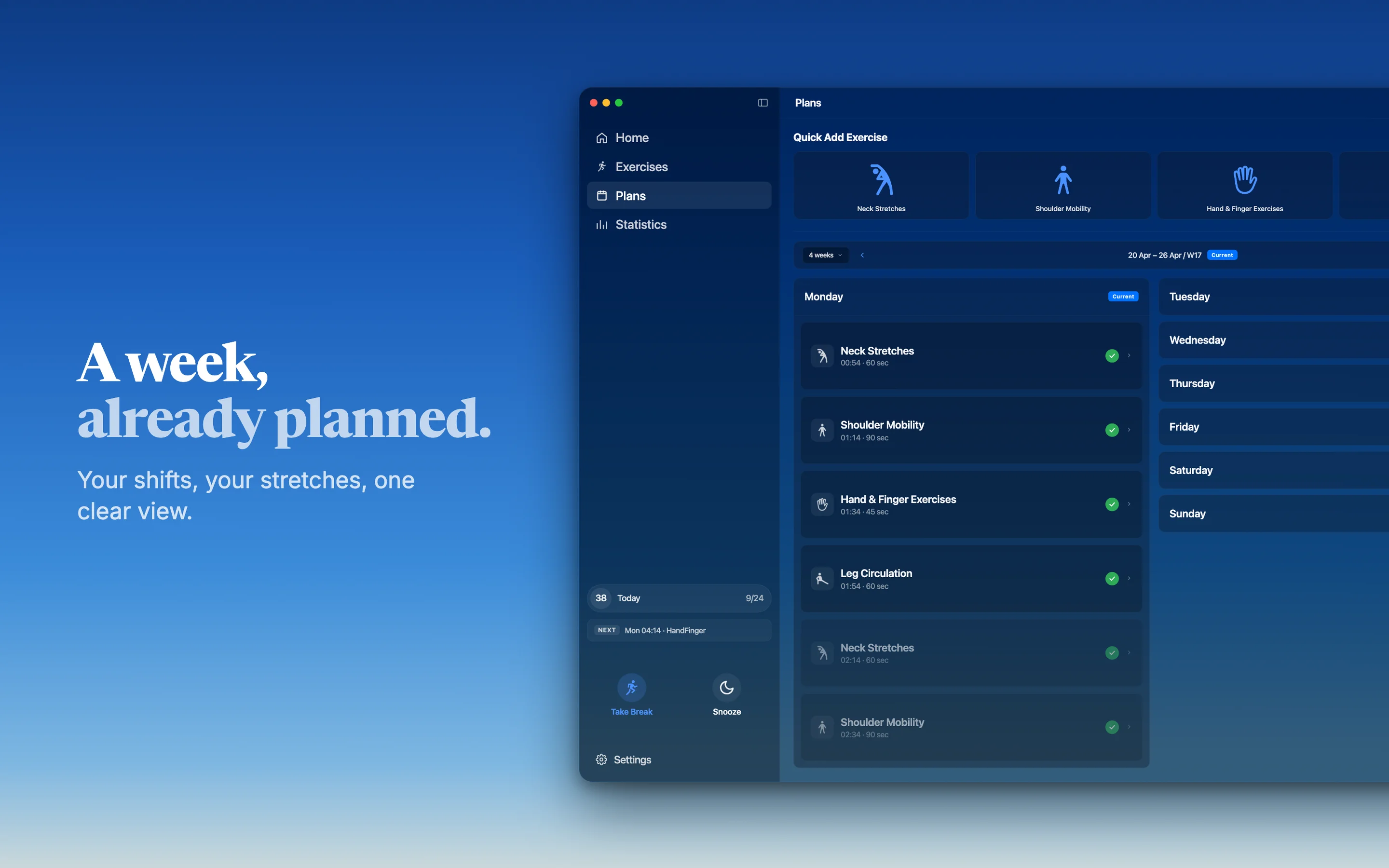
Stiff neck by lunch, sore wrists by 4 PM, heavy legs by the commute home. A simple desk routine for office workers is one body area per break: about 60 seconds of gentle movement every 20 to 40 minutes. Rotate neck, shoulders, wrists and legs so no area stays still for hours.
Each move below gets a short how-to; our in-depth neck and RSI guides cover full steps and warning signs.
Why sitting still all day adds up
Desk work rarely strains you through one big movement. Instead, a few muscles hold your head, shoulders and hands in place for hours while your legs barely move. The UK Health and Safety Executive (HSE) says incorrect screen use or poorly designed workstations can lead to pain in the neck, shoulders, back, arms, wrists and hands.
On a typical desk day, that can look like this:
- A stiff neck and tight upper shoulders by midday, often worse on a MacBook or other laptop with the screen below eye level
- Achy wrists and fingers after long stretches of typing and trackpad work
- Stiff hips and restless, heavy legs after a long meeting or a late evening at the screen
Only a clinician can diagnose what is behind these signs, so if a warning sign in the safety section applies to you, get checked before trying the moves.
The one-area-per-break rule
The HSE advises short, frequent breaks rather than longer, less frequent ones: for example, 5 to 10 minutes every hour beats 20 minutes every 2 hours. Breaks should let you get up and move around, or at least stretch and change posture.
One body area per break turns that advice into a habit. Every 20 to 40 minutes, pick the stiffest area and do one or two of its moves for about 60 seconds. Next time, choose a different area.
These resets fill the gaps between longer breaks; they do not replace them. In a study of computer workers, McLean and colleagues compared work sessions without breaks against three microbreak patterns: whenever the workers chose, every 20 minutes or every 40 minutes. The breaks reduced discomfort in all four areas studied: the neck, shoulders, lower back and forearms. The benefit was clearest at 20-minute intervals, with no sign that the breaks hurt productivity.
Sample routines for a 9-to-5 day and a night shift
For example, an analyst working 9 to 5 with a break every 40 minutes might rotate like this:
- 9:40, neck: 5 chin tucks and a side neck stretch on each side.
- 10:20, wrists and hands: wrist circles, then finger spreads and fists.
- 11:00, legs: 10 calf raises and ankle circles on each foot.
- 11:40, shoulders: slow shoulder rolls and 5 shoulder blade squeezes.
After lunch she starts again from the neck.
For example, a dispatcher working 10 PM to 6 AM might take a break every 20 minutes, since quiet hours after midnight can pass without leaving the chair. That could be the neck at 11:20 PM, hands at 11:40, legs at midnight and shoulders at 12:20 AM, then the neck again. Our guide to break reminders for night shift workers covers planning a whole night.
Neck and shoulders: 6 moves
Sit tall with both feet on the floor. Move slowly, breathe normally and stop at a mild stretch, never at pain. Full steps, common mistakes and more options are in our guide to neck stretches you can do at your desk.
- Chin tuck. Look straight ahead and glide your chin straight back, as if making a double chin, with your eyes level. Hold for 5 seconds, relax and repeat 10 times.
- Side neck stretch. Keep both shoulders down and tilt one ear toward the same shoulder until you feel a mild stretch along the other side of your neck. Hold for 15 to 30 seconds, then switch sides.
- Neck rotation. Keep your chin level and slowly turn to look over one shoulder, only as far as is comfortable, then pause for 2 seconds. Do 5 slow turns to each side.
- Shoulder rolls. Let your arms hang loosely, lift your shoulders toward your ears, roll them back and let them drop. Do 5 to 10 slow backward rolls.
- Shoulder blade squeeze. Draw your shoulder blades gently back and slightly down, as if holding a pencil between them, without arching your lower back. Hold for 5 seconds and repeat 10 times.
- Overhead reach. Interlace your fingers, turn your palms up and press your arms toward the ceiling until you feel a stretch along your sides and shoulders. Hold for 10 to 15 seconds and repeat 3 times, and skip it if raising your arms hurts.
Leave out full head circles or rolls that tip your head back.
Wrists and hands: 3 moves
Typing and trackpad work keep your fingers and wrists busy in a small range of motion for hours. These three moves take about a minute. Skip any move that brings on tingling or numbness.
- Wrist circles. Hold your forearms in front of you with your hands relaxed, then slowly circle your wrists 10 times in each direction. Keep the circles small and smooth.
- Finger spreads and fists. Spread your fingers as wide as is comfortable and hold for 5 seconds, then close them into a gentle fist for 5 seconds. Repeat 5 times.
- Hand shake-out. Let your arms hang by your sides and gently shake your hands and wrists loose for about 10 seconds.
For keyboard height, trackpad habits and hand symptoms that need a doctor, see our guide to RSI at the computer.
Legs: 3 moves
Your legs do the least work at a desk. These seated moves are quiet enough for a video call and may help you feel less stiff. For seated exercises, the NHS recommends a solid, stable chair that does not have wheels.
- Seated leg extension. Sit tall and straighten one knee until your leg is out in front of you, toes pointing up, and hold for 5 seconds. Lower it with control and do 10 on each leg.
- Calf raises. With both feet flat on the floor, lift your heels as high as is comfortable, pause for 2 seconds and lower them slowly. Do 10 to 15, or stand and hold the edge of your desk for a stronger version.
- Ankle circles. Lift one foot slightly off the floor and circle your ankle 10 times in each direction. Then switch feet.
No seated move replaces getting up. MedlinePlus suggests getting up and moving around at least once an hour, for example standing during calls or walking over to a colleague instead of sending an email.
Safety and limits
Stop right away if a move causes sharp pain, dizziness, or tingling, numbness or weakness in an arm, hand or leg. Check with a doctor or physiotherapist first if you are pregnant, have had recent surgery or injury, or have chronic pain or a joint, muscle or nerve condition.
Seek emergency care (call 911 in the US or 999 in the UK) if you have:
- Pain and swelling in one leg together with shortness of breath or chest pain
- Sudden pain, pressure or squeezing in your chest that does not go away, or chest pain that spreads to your arm, neck, jaw, stomach or back
- Chest pain with sweating, feeling sick, light-headedness or shortness of breath
Book a doctor or physio if you have:
- Throbbing pain or swelling in one leg, usually in the calf or thigh: ask for an urgent doctor's appointment (in the UK, NHS 111 can also help)
- Pain, stiffness, tingling or numbness in your hands, wrists or arms that is not going away or is getting worse
- Any other pain that is not going away, is getting worse or worries you
This list summarizes NHS guidance (see Sources), and the neck stretch guide's warning signs cover the neck in more detail. Only a clinician can diagnose what is causing your symptoms.
This article is for general information, not medical advice. 60sReset is not a medical device and cannot diagnose any condition.
If remembering is the hard part, 60sReset can remind you every 20, 40 or 60 minutes, so each reminder becomes your cue to move the next body area. The Mac app times reminders to your work hours, including night shifts that run past midnight, and you can snooze a reminder for 2 minutes if it lands mid-call. It cannot see how you move or tell whether your pain needs a clinician; it only prompts the break.
Desk exercise FAQ
How often should office workers do desk exercises?
A short movement break every 20 to 40 minutes is a practical target. The HSE advises short, frequent breaks over long, rare ones, and in one study of computer workers, microbreaks every 20 minutes showed the clearest drop in discomfort. One body area per break keeps each stop to about a minute.
Can you exercise at your desk without anyone noticing?
Yes, several moves are close to invisible. Ankle circles, seated calf raises, chin tucks, shoulder blade squeezes and finger spreads all work quietly from your chair, even on a video call. Save the overhead reach for moments off camera, and keep every move slow and small.
Do desk exercises replace a workout?
No. The NHS advises adults to get at least 150 minutes of moderate activity or 75 minutes of vigorous activity a week, plus strengthening on at least 2 days a week. It also advises breaking up long periods of not moving, which desk exercises can do. A 2022 review found micro-breaks gave small lifts in energy and drops in fatigue.
Sources
Links checked on 20 October 2026.
- Health and Safety Executive (HSE). Working safely with display screen equipment: Overview and Work routine and breaks.
- McLean L, et al. Computer terminal work and the benefit of microbreaks. Applied Ergonomics, 2001;32(3):225-237. PMID 11394463.
- Albulescu P, et al. Give me a break! A systematic review and meta-analysis on the efficacy of micro-breaks for increasing well-being and performance. PLoS One, 2022;17(8):e0272460. PMID 36044424.
- NHS: Sitting exercises, Physical activity guidelines for adults aged 19 to 64, Deep vein thrombosis (DVT), Chest pain and Repetitive strain injury (RSI).
- MedlinePlus, US National Library of Medicine. Health risks of an inactive lifestyle.